By Matteo De Falco – Professional Fly Fishing Guide in Northern Italy
There is something extraordinary about watching a trout rise to a dry fly.
You see the fish approaching, sometimes slowly, sometimes with surprising aggression. For a brief moment, everything seems to stop. Then the trout opens its mouth, takes your imitation, and disappears beneath the surface.
After more than thirty years of fly fishing, I still find this moment as exciting as the first time I experienced it.
For me, dry fly fishing represents the very essence of fly fishing.
But catching trout on dry flies is not simply a matter of choosing the right imitation and making a good cast.
It requires observation, understanding the river, interpreting trout behaviour, and knowing when to act.
And sometimes, knowing when not to act is even more important.
Understanding the River Before Making the First Cast
One of the most common mistakes I see among fly fishermen is approaching a river with a predetermined idea of how they should fish.
They arrive, select a fly, and immediately begin casting.
I prefer a different approach.
Before doing anything, I try to understand what the river is telling me.
Where are the trout likely to hold? Which currents provide food without forcing fish to waste too much energy? Are there insects drifting on the surface? Is there any visible feeding activity?
These observations help me decide how to approach the water.
However, there is something important to understand: fly fishing rarely provides a single correct answer.
A trout may be holding in an apparently perfect position without showing any interest in surface insects. Another fish might be rising regularly in a place where you would never expect to find it.
Experience helps us interpret these situations, but it never eliminates uncertainty.
That uncertainty is part of what makes fly fishing so fascinating.
Reading Currents: Where Trout Choose to Feed
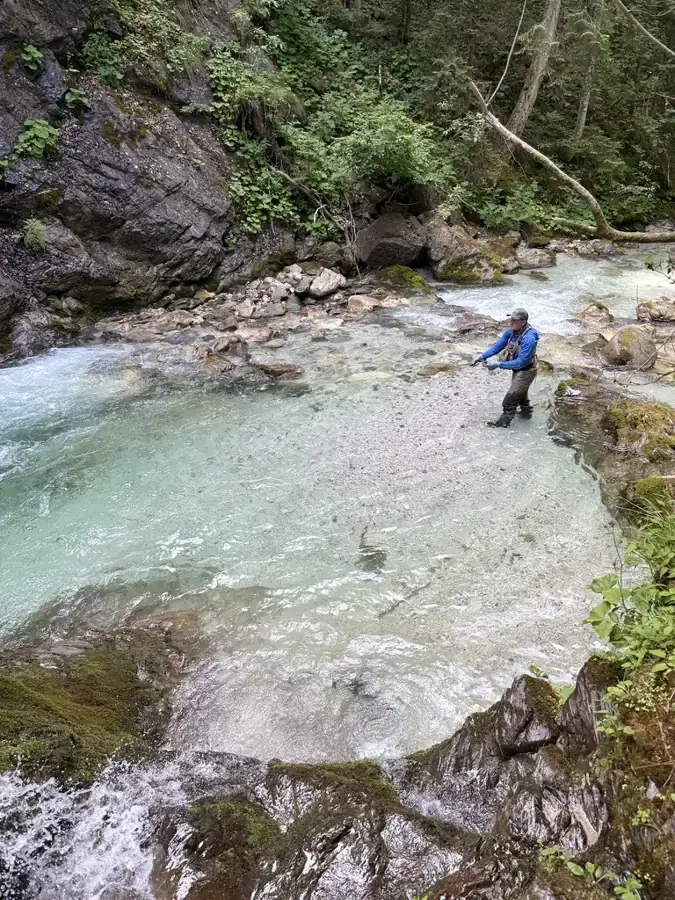
Understanding currents is one of the most important skills in dry fly fishing.
A river is not simply water flowing downstream.
It is a complex combination of currents, changes in depth, obstacles, and feeding opportunities.
Trout generally look for positions where they can obtain food while limiting their energy expenditure.
This is particularly important when fishing for large trout.
A big fish does not necessarily want to spend its entire day fighting powerful currents.
It may prefer a relatively slow section of water, especially when conditions allow insects to drift directly towards its position.
But the situation changes throughout the season.
During summer, for example, I often enjoy fishing extremely fast water with large terrestrial imitations.
These are places where trout have very little time to inspect an artificial fly.
Sometimes they attack with astonishing speed.
Understanding where and why fish feed is far more useful than simply casting into every attractive-looking section of the river.
Matching the Hatch: How Important Is the Right Fly?
When I find a trout rising regularly, one of my first priorities is understanding what it is eating.
If several insect species are drifting downstream, I observe which ones the trout seems to prefer.
Sometimes the answer is obvious.
You can see a fish ignoring certain insects while consistently rising to another species.
In that situation, matching the natural insect is clearly the most logical starting point.
However, choosing the right imitation is only part of the process.
Presentation is equally important.
A perfectly matched fly drifting unnaturally across the current may be completely ignored.
On the other hand, a less accurate imitation presented correctly can sometimes produce an immediate rise.
This is why I never consider fly selection and presentation as separate subjects.
They are closely connected.
And neither can compensate for every mistake made with the other.
Presentation and Drag: Small Details Make the Difference
Drag is one of the greatest challenges in dry fly fishing.
When different currents pull the fly line and leader at different speeds, the artificial fly begins moving unnaturally.
Trout can immediately recognise this movement.
Fortunately, there are several ways to reduce drag.
A longer leader can help. Changing the cast or adjusting the way the leader lands on the water may also improve the drift.
Sometimes the most effective solution is simply moving to another position.
Of course, this must be done without disturbing the fish.
I often tell anglers that fishing is made of many small details.
A slightly better position, a longer leader, a more suitable cast, or a few extra seconds spent observing the current.
Individually, these adjustments may seem insignificant.
Together, they can make the difference between catching a trout and watching it refuse your fly.
There is rarely one magical solution.
Successful dry fly fishing is usually the result of several small decisions made correctly.
Why Positioning Matters More Than Casting Distance
Good casting skills are certainly useful.
Being able to control the fly line, manage difficult currents, and present a dry fly accurately makes fishing easier.
But I believe many anglers overestimate the importance of casting distance.
Most trout are caught at short or medium distances.
Sometimes taking one additional step, or simply choosing a better position, can eliminate the need for a complicated cast.
This is particularly true when fishing rivers with multiple currents.
A long cast may force the fly line to cross several different flows, making a natural drift almost impossible.
Moving closer, when conditions allow it, can completely change the situation.
I would rather make a simple, accurate cast from the correct position than a spectacular cast from the wrong one.
The objective is not to demonstrate casting ability.
The objective is to present the fly naturally to the fish.
When Trout Are Not Rising: Fishing Blind With Dry Flies
Dry fly fishing is also a personal choice.
There are days when other techniques would undoubtedly produce more fish.
Euro nymphing, for example, can be extremely effective when trout are feeding beneath the surface.
But sometimes I simply want to fish dry flies.
And there is absolutely nothing wrong with that.
If I decide to spend the entire day fishing on the surface, I accept that I may be trying to convince trout to behave differently from their natural feeding pattern.
When there is no visible surface activity, I begin searching likely holding areas.
This approach is commonly called blind dry fly fishing.
I cast towards places where I believe trout may be waiting for food.
In these situations, I often prefer slightly larger, more visible flies.
The objective is to attract the attention of a fish and encourage it to rise.
Of course, observing insects remains important.
But insect activity does not always correspond directly with trout activity.
I have experienced situations where hundreds of insects were drifting downstream without a single trout rising.
And I have seen rivers with very few visible insects where fish were rising constantly.
Once again, there is no universal rule.
Large Terrestrial Flies: An Almost Streamer-Like Approach
One of my favourite summer techniques involves fishing very large dry flies in fast or extremely fast water.
I am talking about patterns such as Chernobyl Ants, Madame X, and Fat Alberts, sometimes tied on hooks as large as size 2 or even size 1.
These are not delicate imitations intended for selective trout feeding during a hatch.
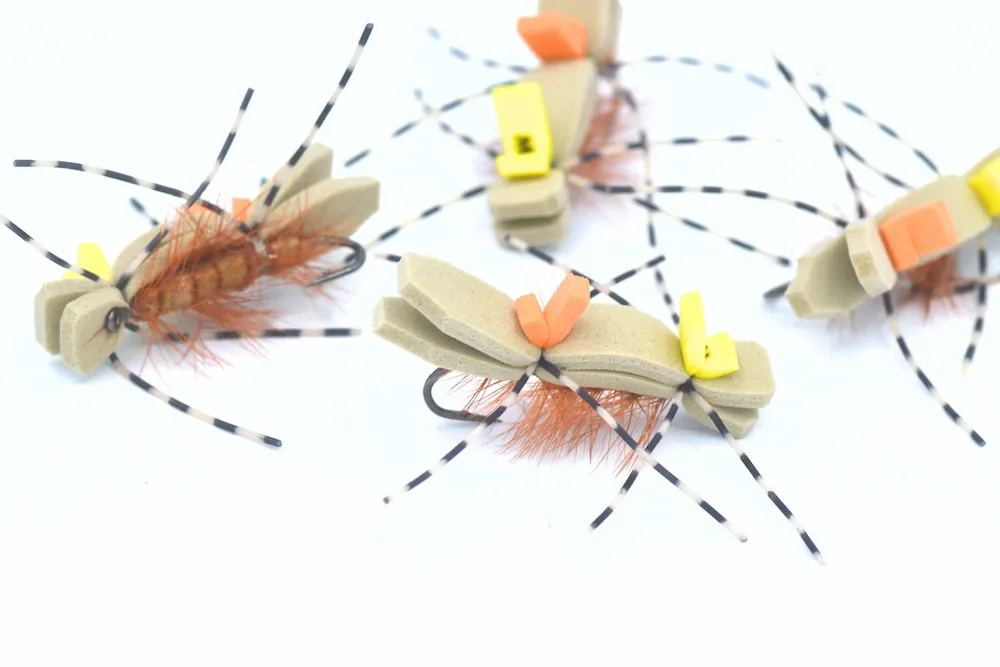
They are substantial artificial flies designed to attract attention.
In some respects, this approach resembles streamer fishing on the surface.
The trout often reacts instinctively.
In powerful currents, fish have very little time to examine an artificial fly.
They must decide quickly whether to attack or let a potential meal disappear downstream.
And sometimes the reaction is spectacular.
A large trout can rise towards one of these flies like a missile.
Because of the speed and violence of these takes, I frequently use strong tippets, sometimes 1X or 2X.
This is a very different experience from presenting a tiny mayfly imitation to a selective trout in slow water.
But both approaches belong to the extraordinary world of dry fly fishing.
The Importance of Watching a Rising Trout
When I find a large trout rising regularly, my first instinct is not to cast.
It is to observe.
I want to understand what the fish is eating, where it is positioned, and how it moves to intercept insects.
Sometimes a trout repeatedly moves towards one side of the current.
Sometimes it rises almost without changing position.
These details help me understand where the fish is actually holding.
I also pay attention to the frequency of its rises.
If a trout is feeding every three or five seconds, I try to respect that rhythm.
I do not necessarily cast immediately after a rise.
Instead, I may wait briefly and present the fly at a moment that fits the fish's feeding pattern.
Most importantly, I try to avoid disturbing the trout with my first casts.
Those initial presentations do not always need to be perfect.
They must, however, be sufficiently controlled to avoid frightening the fish.
Once I understand the distance and the behaviour of the currents, I can gradually improve my accuracy.
There is no reason to rush.
The Biggest Mistake in Dry Fly Fishing: Being in a Hurry
After many years guiding anglers, I believe one of the most common mistakes in dry fly fishing is impatience.
The moment someone sees a trout rising, something changes.
The excitement takes over.
Suddenly, the only objective is to cast as quickly as possible.
I understand that feeling perfectly.
But it often leads to unnecessary mistakes.
If the trout is feeding regularly and there is no immediate risk of disturbing it, why rush?
Watching the fish for another thirty seconds may reveal something important.
Perhaps it is feeding on a particular insect.
Perhaps it is moving several centimetres to one side before every rise.
Perhaps its feeding rhythm is more predictable than it initially appeared.
These observations can make the first presentation significantly more effective.
In dry fly fishing, patience is not simply a virtue.
It is a practical fishing skill.
When to Strike: The Challenge of Large Trout
One of the most exciting moments in dry fly fishing is also one of the easiest to get wrong.
The strike.
Many anglers believe they must react immediately when a trout approaches their fly.
In reality, timing depends greatly on how the fish takes the imitation.
In my experience, some of the most difficult trout to hook are those that rise very slowly.
This is especially true with large fish.
A big trout has a large mouth, and when it approaches a dry fly slowly, the temptation to strike immediately can be overwhelming.
You see the mouth opening.
Your instinct tells you to lift the rod.
But this is often exactly the wrong moment.
If you strike too early, you may literally pull the fly away before the fish has closed its mouth.
The solution requires patience and self-control.
I try to wait until the trout has closed its mouth and its head has started moving back beneath the surface.
That is the moment to strike.
It sounds simple.
But when a huge trout rises slowly towards your fly, waiting those extra moments can feel incredibly difficult.
Experience makes a tremendous difference.
Dry Fly Fishing for Marble Trout in Italy
One of the greatest attractions of fly fishing in Northern Italy is the opportunity to encounter truly large trout.
And among these fish, the marble trout holds a special place.
The marble trout (Salmo marmoratus) is one of the most fascinating salmonids found in our rivers.
Its size, strength, and extraordinary appearance make it a remarkable fish.
But there is something that surprises many visiting anglers.
Marble trout also rise to dry flies.
In fact, when they are actively feeding on the surface, they can sometimes be less selective than wild brown trout.
This does not mean they are easy to catch.
Far from it.
But it creates opportunities that many international anglers do not expect.
Imagine watching a large marble trout rising slowly from the depths.
You see its shape approaching the surface.
The fish seems to move in slow motion.
Then it opens its enormous mouth and takes your artificial fly.
It is an experience that is difficult to forget.
For me, the possibility of catching a large marble trout on a dry fly is one of the most exciting reasons to explore the rivers of Northern Italy.
The Best Season for Dry Fly Fishing in Northern Italy
One of the questions I receive most frequently from visiting anglers concerns the best time of year for dry fly fishing.
My answer is that every season offers different opportunities.
And some of the most interesting periods are not necessarily those people expect.
March and April: Unexpected Opportunities for Large Trout
Experience has taught me that the beginning of the season can provide extraordinary dry fly fishing.
March and April are particularly interesting.
During these months, large trout may prefer slower currents where they can feed without wasting too much energy.
When conditions are favourable, these fish can rise with remarkable consistency.
In fact, early spring can be one of the best periods of the year to encounter large trout willing to take a dry fly.
This often surprises anglers who associate dry fly fishing primarily with warmer weather.
But some of my most memorable encounters with large rising trout have taken place at the beginning of the season.
Late Spring: Changing Hatches and Feeding Behaviour
As the season progresses, insect activity and trout behaviour change.
Different hatches create new opportunities.
The most effective approach depends on the river, the weather, and the conditions on that particular day.
This is why I prefer not to promise a specific hatch or a particular type of fishing months in advance.
Understanding the river on the day of the trip is far more important than following a rigid seasonal plan.
Summer: Early Mornings, Late Evenings and Big Terrestrials
During summer, surface activity often becomes more concentrated in the early morning and late afternoon or evening.
These can be excellent moments to fish during natural hatches.
However, hot weather does not necessarily mean dry fly fishing becomes less interesting.
Quite the opposite.
Some of my favourite summer sessions take place in fast and extremely fast water.
This is when large terrestrial imitations can become particularly effective.
Watching a trout explode through a powerful current to attack a large floating fly is a completely different experience from delicate hatch fishing.
And it can be just as exciting.
The key is adapting the technique to the conditions rather than expecting the river to behave the same way throughout the year.
Why Every River Requires a Different Approach
Northern Italy offers an extraordinary variety of fly fishing environments.
Large alpine rivers, powerful currents, slower sections, and complex water structures create very different fishing situations.
There is no single technique that works everywhere.
And there is no single approach that works every day.
Sometimes the best decision is changing the fly.
Sometimes it is changing the leader.
Sometimes it is moving a few metres.
And sometimes the best decision is simply waiting.
The more experience I gain, the more convinced I become that successful fly fishing is not about discovering one perfect solution.
It is about learning to recognise the many small details that influence the behaviour of fish.
Experience Dry Fly Fishing in Northern Italy
For anglers visiting Italy, dry fly fishing can offer much more than the opportunity to catch beautiful trout.
It is a way to discover the character of our alpine rivers.
It requires understanding currents, observing insects, studying fish behaviour, and adapting to constantly changing conditions.
During my private guided fly fishing days, I always try to build the experience around the river and the angler.
Some days offer excellent opportunities to target rising trout.
On other days, searching the water with larger dry flies may be the most interesting approach.
And sometimes conditions suggest that another technique would be more productive.
The decision ultimately depends on the objectives of the person I am guiding.
Because fishing is not always about catching the greatest possible number of fish.
Sometimes it is about catching one fish in exactly the way you want.
The Magic of Dry Fly Fishing
After more than thirty years on the water, I have experienced many extraordinary moments with a fly rod.
I have caught fish using different techniques, explored countless rivers, and spent thousands of hours observing trout.
But dry fly fishing still creates a particular emotion.
There is something magical about watching an animal consciously leave its own element to capture something floating outside it.
A trout rising towards a dry fly is crossing the boundary between two worlds.
And for a brief moment, the angler becomes part of that extraordinary interaction.
For me, dry fly fishing is the very essence of fly fishing.
Every trout caught on a dry fly carries something magical.
And I don't think that feeling will ever disappear.
If you are planning a fly fishing trip to Northern Italy, you can discover more about my Private Guided Fly Fishing Days or learn about my experience and approach on the About Me page.
You can also explore my articles about Euro Nymphing and Streamer Fishing to understand the different techniques available on our rivers.