Euro Nymphing: A Complete Guide to Technique, Equipment and Natural Drift
What 30 Years of Fly Fishing Have Taught Me
By Matteo De Falco | Fly Fishing Venice
A technique built on observation
Euro Nymphing is often presented as a shortcut to catching trout. I understand why: in the right hands, it can be extraordinarily effective. But describing it only by the number of fish caught misses the best part. For me, Euro Nymphing is a constant exercise in reading water, interpreting currents and deciding how an artificial nymph should travel through them.
The basic idea is accessible even if you have never tried it. Instead of relying on a conventional fly-line cast, you use a long rod, a thin leader system and one or two weighted nymphs. A short, visible section of line—the sighter—helps you follow the drift and recognize takes. The challenge is not simply getting the flies underwater. It is getting them to move as naturally as the insects trout already eat.
After more than thirty years on rivers, I have learned that the river does not adapt to what we want. We have to adapt to the river. Sometimes that means fishing a dry fly, sometimes a streamer, and sometimes Euro Nymphing. There is no reason to impose our favorite technique on conditions that suggest another approach. Even within Euro Nymphing, the same setup should not dictate how we fish every pool and every current.
Start by reading the water
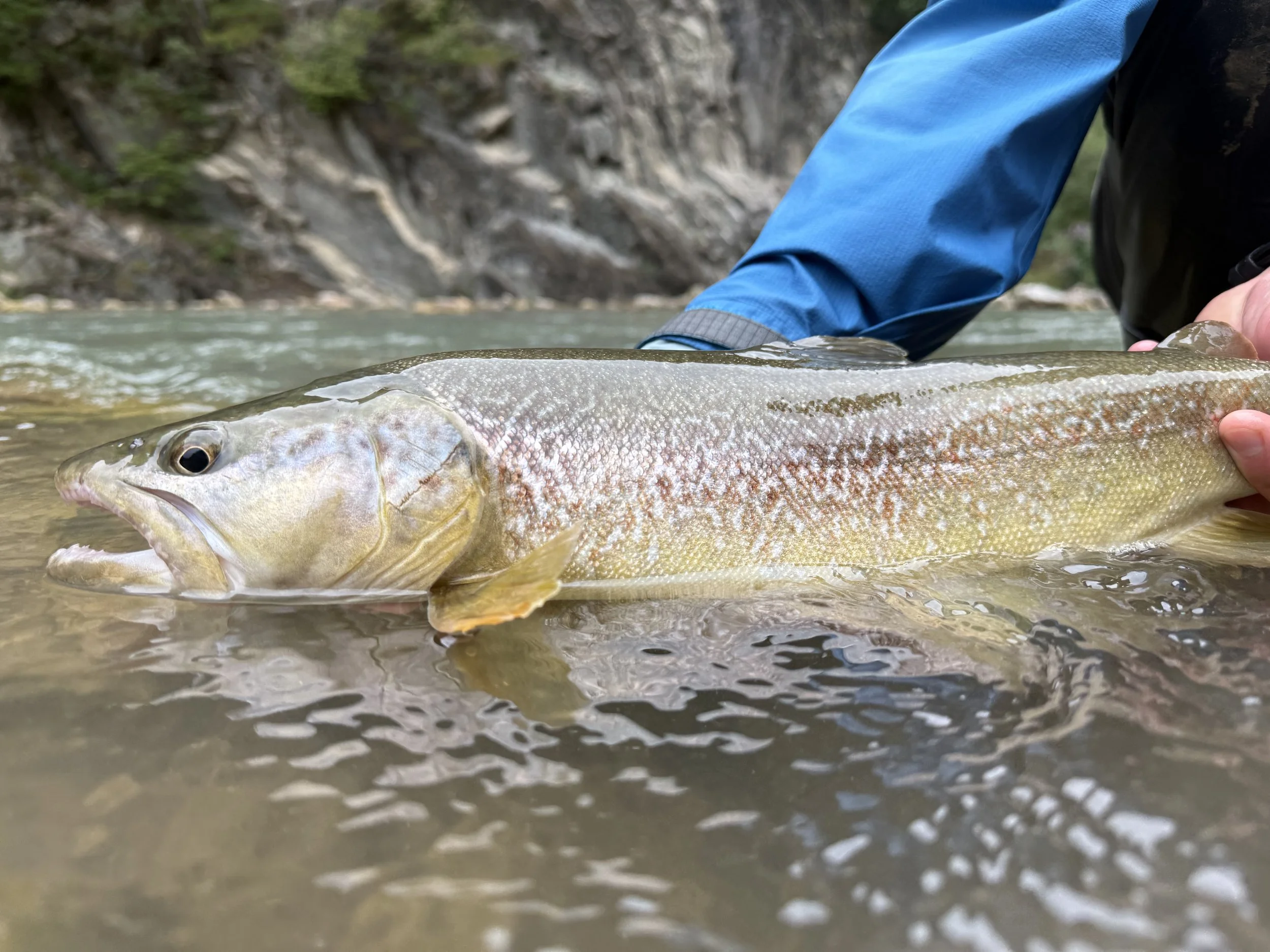
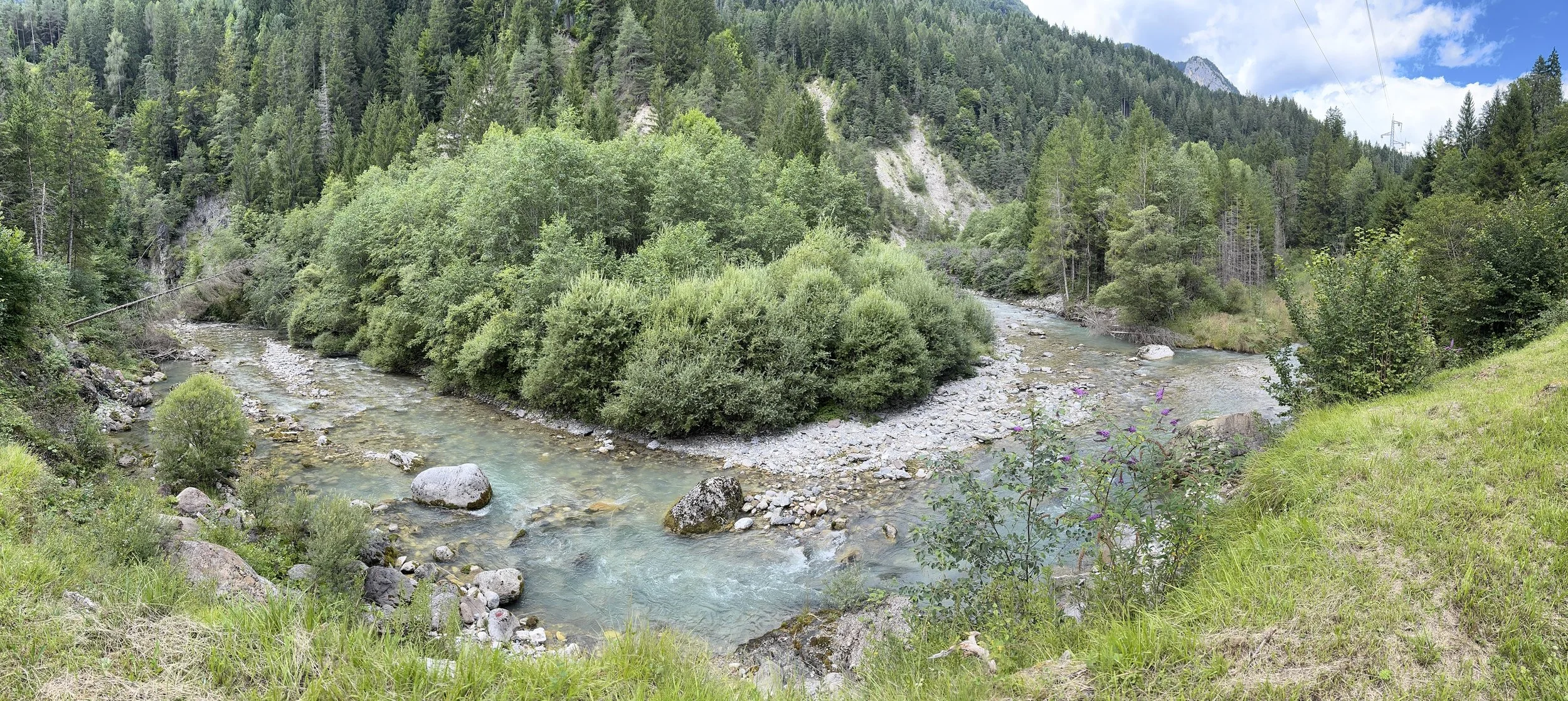
Before I choose my nymphs, I look at the water. Where does the current deliver food? Where can a trout hold without spending too much energy? I pay attention to seams, changes in depth, rocks, boulders and the softer water beside faster lanes. A trout often takes advantage of the current rather than fighting it.
This matters whether I am fishing for brown trout, rainbow trout or marble trout. A large fish can still feed on very small aquatic insects. Its size does not automatically mean I need a larger fly. If a small nymph is being taken in a particular current, I have no reason to change its size merely because I suspect a bigger trout is nearby. I may need a different weight or a better drift; that is another question.
I also consider my approach. A promising feeding lane is not much use if I disturb the fish before making the first presentation. Reading water includes reading the bank, the depth I can wade safely and the angle from which I can control the drift.
The most common mistake: too much power in the system
When I guide anglers who already know Euro Nymphing, especially visitors from the United States, I often see a system that is much heavier than the one I use. Sometimes there is 20-pound monofilament on the reel, followed by a sighter and a relatively short tippet. The rod may be perfectly suitable, but the line system introduces resistance that I would rather avoid.
My approach is to simplify and lighten everything. I use a soft nylon monofilament, typically 2X, directly on the reel. Not a tapered leader: straight monofilament. I also like it to be visible, because the section coming off the reel gives me another visual reference in addition to the sighter. The softness matters too. I want the system to follow the presentation without unnecessarily influencing it.
The point is not that every heavier setup is wrong in every situation. It is that a lighter system can reveal a degree of precision and naturalness that anglers may not have experienced. When I show clients this approach on the river, the reaction is often immediate. One of the comments I hear most is: “I can't wait to get home and try this on my own rivers.” That is particularly satisfying: the day has given them something they can use long after they leave Italy.
My leader setup, from the reel to the nymphs
Here is how I assemble the system. I start with the soft, visible 2X nylon directly on the reel. At the end of that monofilament I attach a small micro ring. To that ring I connect approximately 40 centimeters (about 16 inches) of colored sighter. At the other end of the sighter I attach a second micro ring. The tippet then runs from that second ring to the flies.
The feature that surprises many anglers is the tippet length: I generally use a tippet almost as long as the rod itself. On a ten-foot rod, that means nearly ten feet of tippet. It sounds long if you are used to compact nymphing leaders, but it gives me the freedom to fish different depths without constantly rebuilding the system.
Imagine a shallow run with only 40 centimeters of water, followed a few steps later by a channel approaching two meters. With a very short tippet, these changes can demand repeated adjustments. With my longer tippet, I can often adapt by raising or lowering the rod tip, while keeping the sighter above the water whenever the situation allows. The exact working depth still depends on the weight of the nymphs, current speed, angle and distance. Rod height is not magic. But the long tippet gives me useful room to work.
I want the thin tippet in the current, not the thicker sighter. When the sighter drags through the surface, it can pull the flies and interfere with the drift. Keeping it out of the water is therefore not just a matter of seeing takes: it helps protect the presentation.
Two nymphs: spacing and different levels
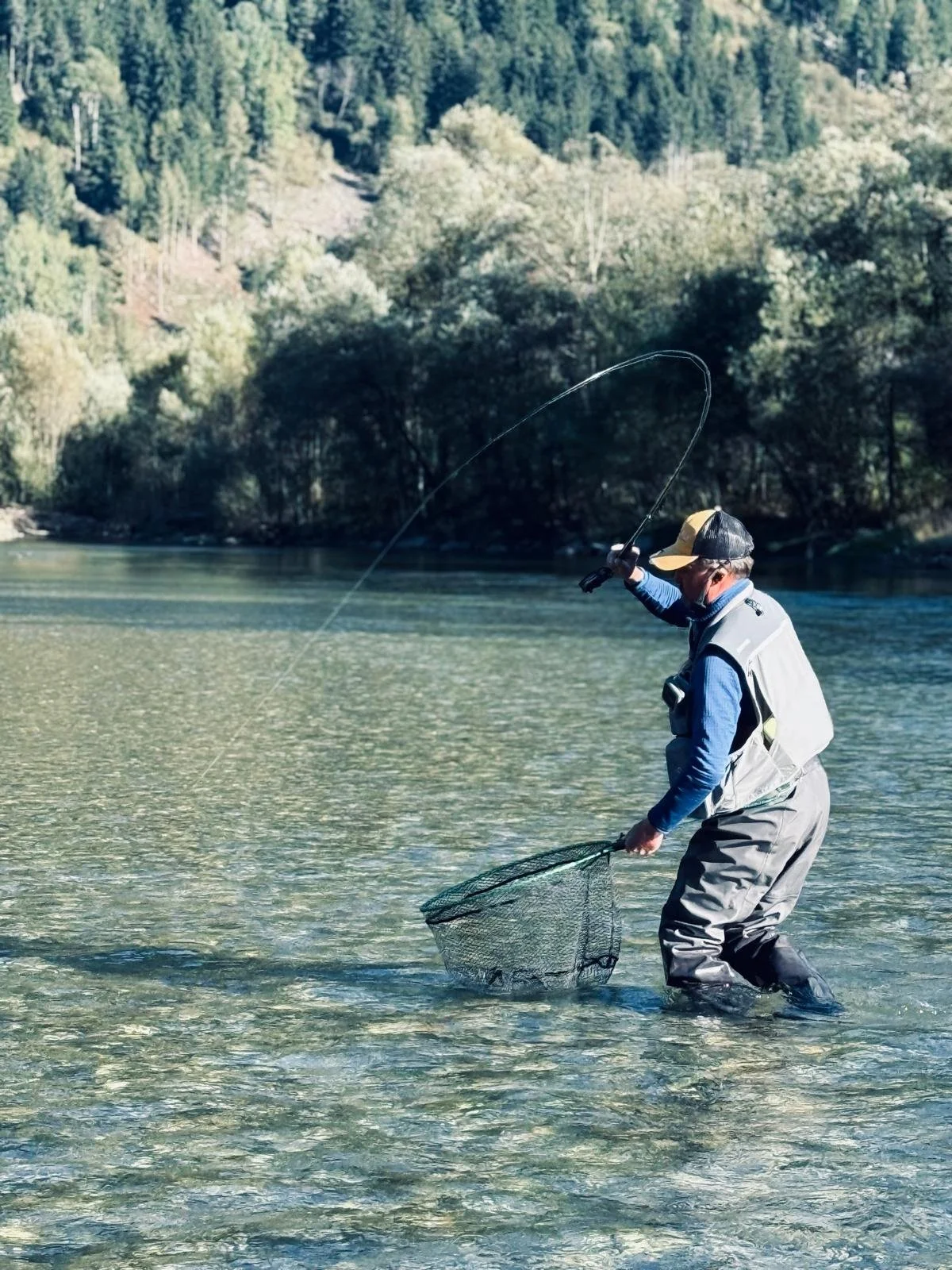
When I fish two nymphs, I generally space them around 40 to 50 centimeters apart—roughly 16 to 20 inches. This gives the system room to work softly through the current. Quite often I put the heavier nymph on the point and a lighter nymph on the dropper. The point fly helps the rig reach the working depth; the lighter fly can move at a different level and respond more freely to subtle variations in flow.
I am not trying to pull two objects through the river as if they were a single weight. I want them to behave like food being carried by water. Natural aquatic insects do not all move in a perfectly rigid formation, and the two flies should not have to do so either. A little separation can help create that softer presentation.
Forty to fifty centimeters is a reference, not a commandment. In particularly fast water I may bring the nymphs closer together to concentrate the weight and help the system penetrate the current. In other circumstances I value the separation and the opportunity to explore different levels. The spacing should serve the water in front of me.
Choosing weight: the danger of laziness
One of the worst habits in Euro Nymphing is deciding which nymphs to use before seeing the water—and then refusing to change them. I often tell clients that laziness is one of the greatest enemies of this technique. You cannot reasonably expect two flies to work equally well in every run, glide and pocket throughout the day.
First, observe. How deep is the water? How fast is it moving? Where do you believe the fish are feeding? If trout are taking food higher in the water column, a lighter combination may allow the flies to work naturally at that level. If they are feeding close to the bottom—which is often the more likely situation—I want enough weight to reach that zone and drift convincingly there.
That does not mean choosing the heaviest nymphs and bouncing them along the riverbed. The goal is not to hit bottom at all costs. It is to let the flies travel at a believable speed and depth, much as natural nymphs carried by the current would. Sometimes I need more weight, sometimes less, and sometimes I discover that the choice I made only minutes earlier is no longer appropriate.
There is no universally correct bead size for a current described as “one meter deep and moderately fast.” Two places with that description may fish very differently. I would rather make a few careful drifts, observe what happens and change the weight than pretend a fixed formula can replace the river.
Where to stand: use the side of the current
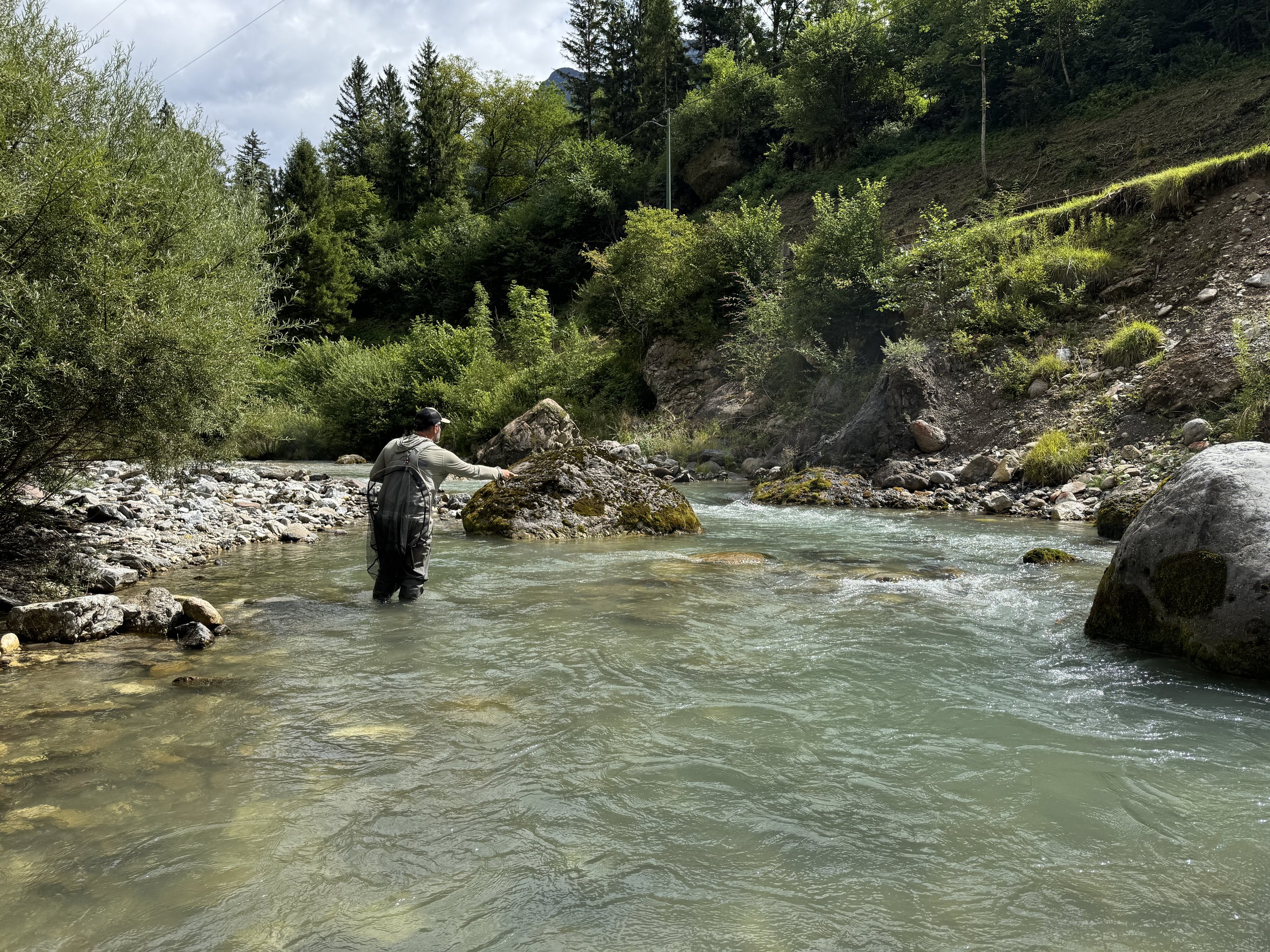
Good Euro Nymphing begins with your position, not your cast. If the river allows it, I prefer to stand to the side of the current I want to fish. On a medium-sized or wider river, that angle makes the drift easier to follow and gives me more control. A long rod is particularly helpful here: I can track the flies while keeping unnecessary line off the water.
You can certainly cast directly upstream. Sometimes you must. But in that situation the current carries the nymphs straight back toward you, and managing the incoming line becomes more complicated. You have to recover slack while avoiding the temptation to pull the flies faster than the water.
For anglers learning the technique, standing alongside the current is often the simpler starting point. It lets them concentrate on the drift and the sighter instead of fighting constantly with line management. Once they understand that rhythm, they can apply the same principles from more demanding angles.
Contact without tension
This may be the most important lesson I teach: learn to stay on the boundary between contact and tension. They are not the same thing. Contact means I can read what is happening to my flies. Tension, if excessive, can start to dictate how those flies move.
There are situations when I deliberately allow the nymphs to drift very freely, even with some slack in the leader. That can be exactly what the current requires. But whenever possible, I try to find the delicate point at which I remain connected to the flies without pulling them. I want the current to carry the nymphs and the rod to follow, not the other way around.
When I find that balance, I can detect a change through the sighter or feel it through the tip of the rod. The line tells me something without imposing too much on the presentation. Too much tension may make the system feel reassuringly direct, but it can also speed up the flies or lift them away from the level where trout are feeding.
This is a skill, not a fixed setting. It changes with current speed, depth, the weight of the flies and the angle of the rod. Sometimes I accept less direct contact to preserve a natural drift. Other times I can maintain excellent sensitivity with almost no visible influence on the nymphs. Learning that boundary is what makes this fishing so engaging.
Reading a take: rock or trout?
Beginners frequently ask me how to tell a fish from a nymph touching a stone. There is no shortcut that replaces experience, but the distinction often becomes clearer surprisingly quickly. When I am working on that boundary between contact and tension, a take can be quite distinct: in my experience it is often faster and slightly longer than the brief stop of a fly meeting a rock. Current speed can change the sensation, of course, so this is a clue rather than an infallible rule.
Sometimes the sighter makes a sudden, irregular movement. Sometimes I feel the take through the rod tip. And sometimes I set the hook without being able to explain why. I see no obvious signal, feel no unmistakable pull, yet something about the drift makes me react—and there is a trout on the other end.
I do not present that as a supernatural ability. After enough hours, your attention learns patterns that are difficult to describe in words. Perhaps the line hesitated or the flies behaved differently for an instant. The brain may recognize it before you consciously identify the signal.
At the beginning of a guided day, clients may strike at stones and miss fish. After hours of watching a well-controlled drift, they often begin to separate those sensations. That learning process is one of the most enjoyable parts of teaching Euro Nymphing. It also shows why the technique deserves more respect than it sometimes receives.
The end of the drift is still fishing
A drift is not necessarily finished when the nymphs pass the point where you expected the take. As the system begins to tighten at the end of the pass, the flies may lift toward the surface. That movement can resemble aquatic insects rising through the water during emergence, and trout may respond to it.
I stay attentive through that last part of the presentation. A carefully controlled lift can be useful, but it is not something I impose automatically on every cast. The important point is to notice what the water and the fish are telling you. A clean dead drift is my foundation; it is not a rule that forbids every other movement.
Rods, sensitivity and playing fish
A longer rod makes it easier to control the angle of the leader and follow a drift. Ten-foot rods are common in Euro Nymphing, and other lengths have their place. Beyond length, I value a sensitive, progressive action that protects fine tippets and allows me to feel what happens underwater.
That sensitivity matters when fighting fish as well. A rod that bends progressively can absorb sudden pressure, but no rod removes the need for judgment. The strength of the current, obstacles, water temperature and the condition of the fish all matter. If a powerful trout moves downstream, I try to maintain a favorable angle and follow safely when necessary. I do not treat fine tippet as a contest to see how long I can fight a fish. The goal is control and an efficient fight.
Is Euro Nymphing really fly fishing?
In Italy, Euro Nymphing is sometimes dismissed as dropping heavy flies into a current and waiting for something to happen. That description ignores the most demanding parts of the technique: choosing the right water, managing the drift, reading tiny changes and adjusting the setup again and again.
I understand why some traditional fly anglers feel it is different. Very little fly line may be involved in the actual presentation, and the casting mechanics are not those of classic dry-fly fishing. I do not need to deny those differences. What I reject is the idea that effectiveness makes a method simple.
In my experience, Euro Nymphing is one of the most effective ways to fish artificial flies. That is my assessment from years on the river, not a scientific ranking. It can also be extraordinarily absorbing. Every drift asks a question, and every adjustment is an attempt to understand the answer.
Let the river decide
If someone tells me that watching a trout rise to a dry fly is more exciting than catching several fish on nymphs, I agree. There is nothing quite like that moment. But we cannot bend the river to our wishes. If the fish are rising, I am happy to fish dry flies. If they are feeding on nymphs, I will fish nymphs. If conditions invite a streamer, that is another possibility.
The point is not to prove that one technique is superior. It is to understand what you are doing and to approach the water correctly. That is the lesson I most want anglers to take home from a day with me. You do not need a rigid formula. You need observation, a willingness to change and the patience to learn how a natural drift really feels.
For me, the best compliment is not always the biggest trout in the net. It is hearing someone say that they cannot wait to use what they learned on their own river. That means the experience continues long after our day together ends.
Matteo De Falco is an Italian fly-fishing guide and the founder of Fly Fishing Venice. This guide reflects his personal fishing experience and approach to teaching Euro Nymphing.