Fly Fishing the Brenta River
Fly Fishing Near Venice: What to Expect from a Guided Day in Northern Italy
By Matteo De Falco | Fly Fishing Venice
The Brenta, from Bassano to the Forest
One of the things I enjoy most is watching someone see the Brenta for the first time.
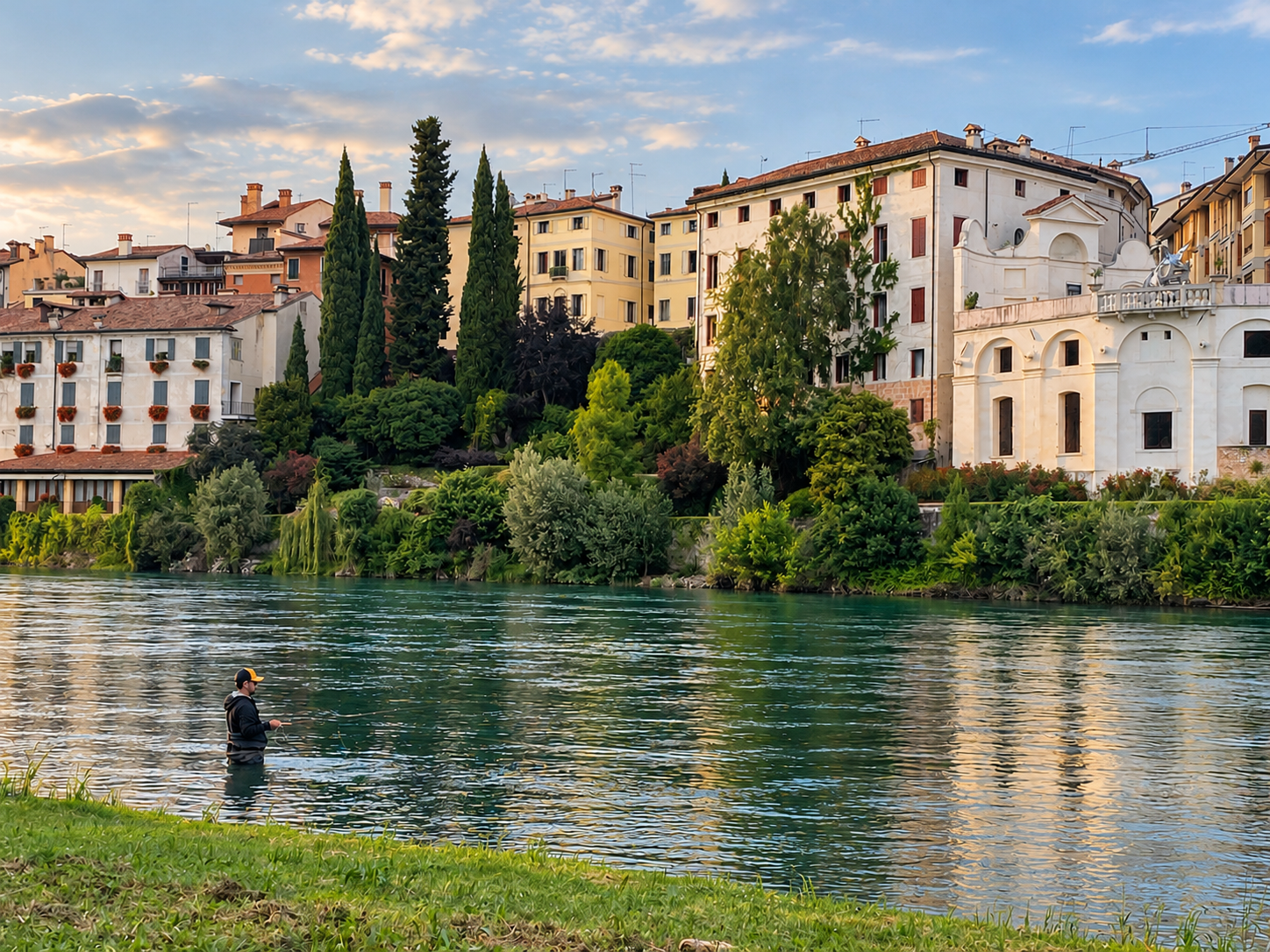
We may begin in Bassano del Grappa, with the river flowing through a beautiful historic Italian town. The angler looks around, asks me about an old bridge, a building or the history of the place.
Then we start moving upstream.
Little by little, the town disappears. The buildings disappear. The roads disappear. There are trees, mountains, clear water — and eventually the only thing you hear is the river.
And we are still fishing the same Brenta.
For anglers visiting Venice, this experience is much closer than many imagine. Bassano del Grappa is roughly an hour to an hour and ten minutes from Venice by car, making it possible to add a full day of serious trout fishing to an Italian vacation without organizing a separate fishing trip.
One River, Many Different Rivers
There are almost 20 miles of fishable water, and the character of the Brenta can change dramatically over a relatively short distance.
In the upper stretches, you can find yourself fishing what feels like a medium-sized mountain stream, with the kind of approach you would normally associate with alpine water. Drive ten miles downstream and the Brenta becomes a much larger river, with long glides, broad currents and completely different fishing situations.
You can start your morning fishing water that feels like a mountain stream and, not long afterwards, find yourself standing in a completely different river. That variety is one of the reasons I never get tired of fishing the Brenta.
It is also what makes a guided day so adaptable. There is no standard day on the Brenta, because there is no standard angler.
Brown Trout, Rainbows — and the Possibility of a Marble Trout
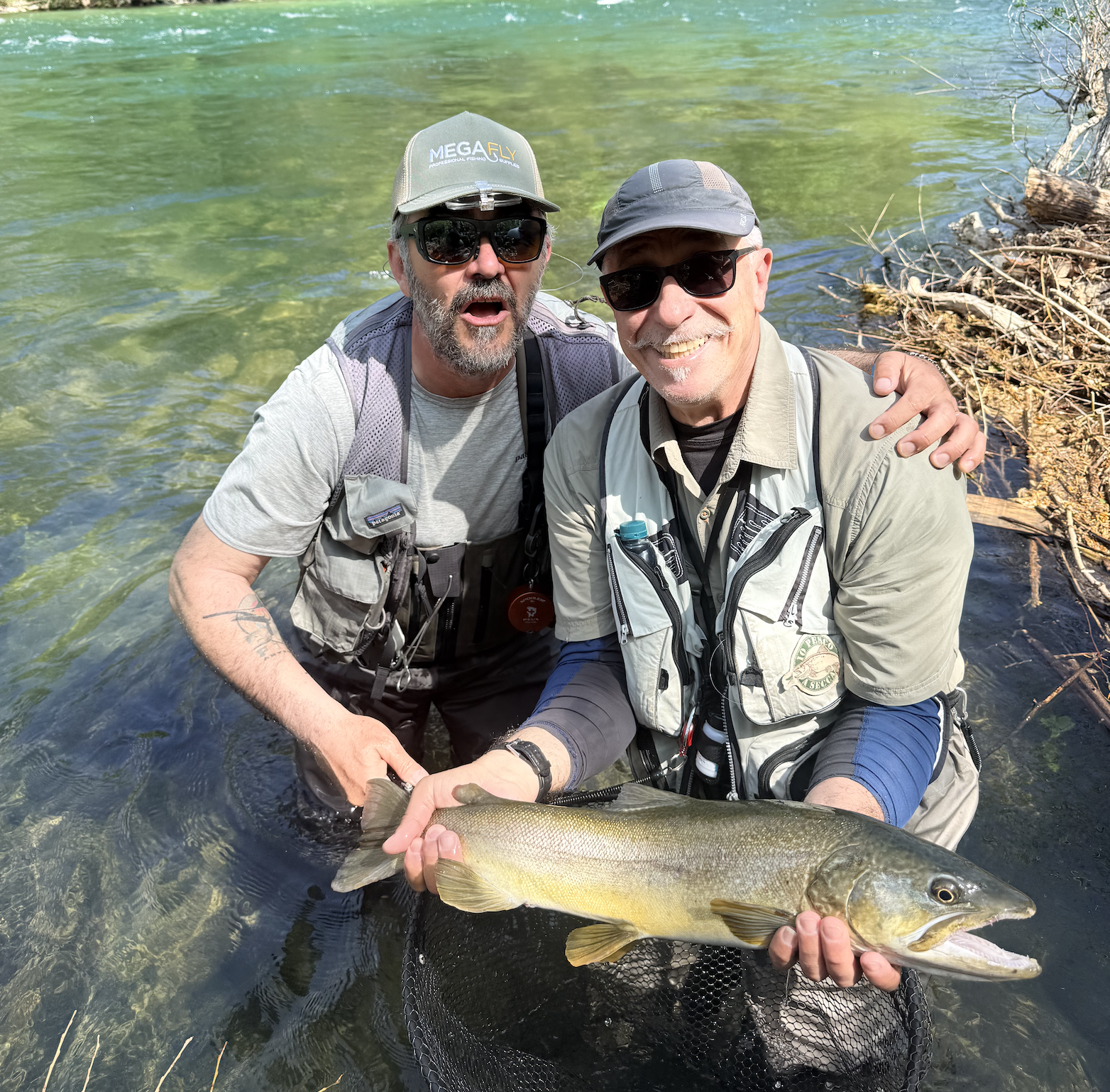
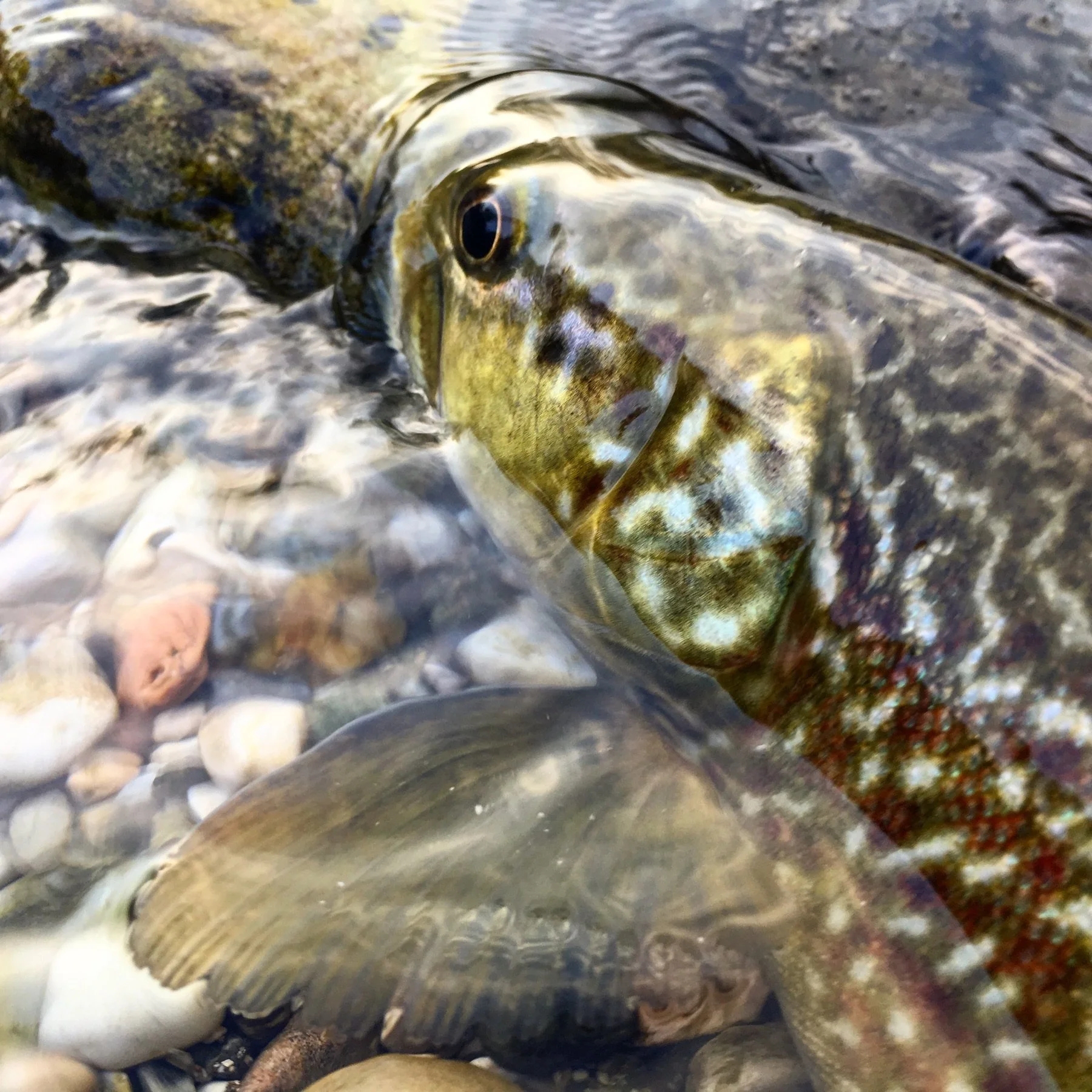
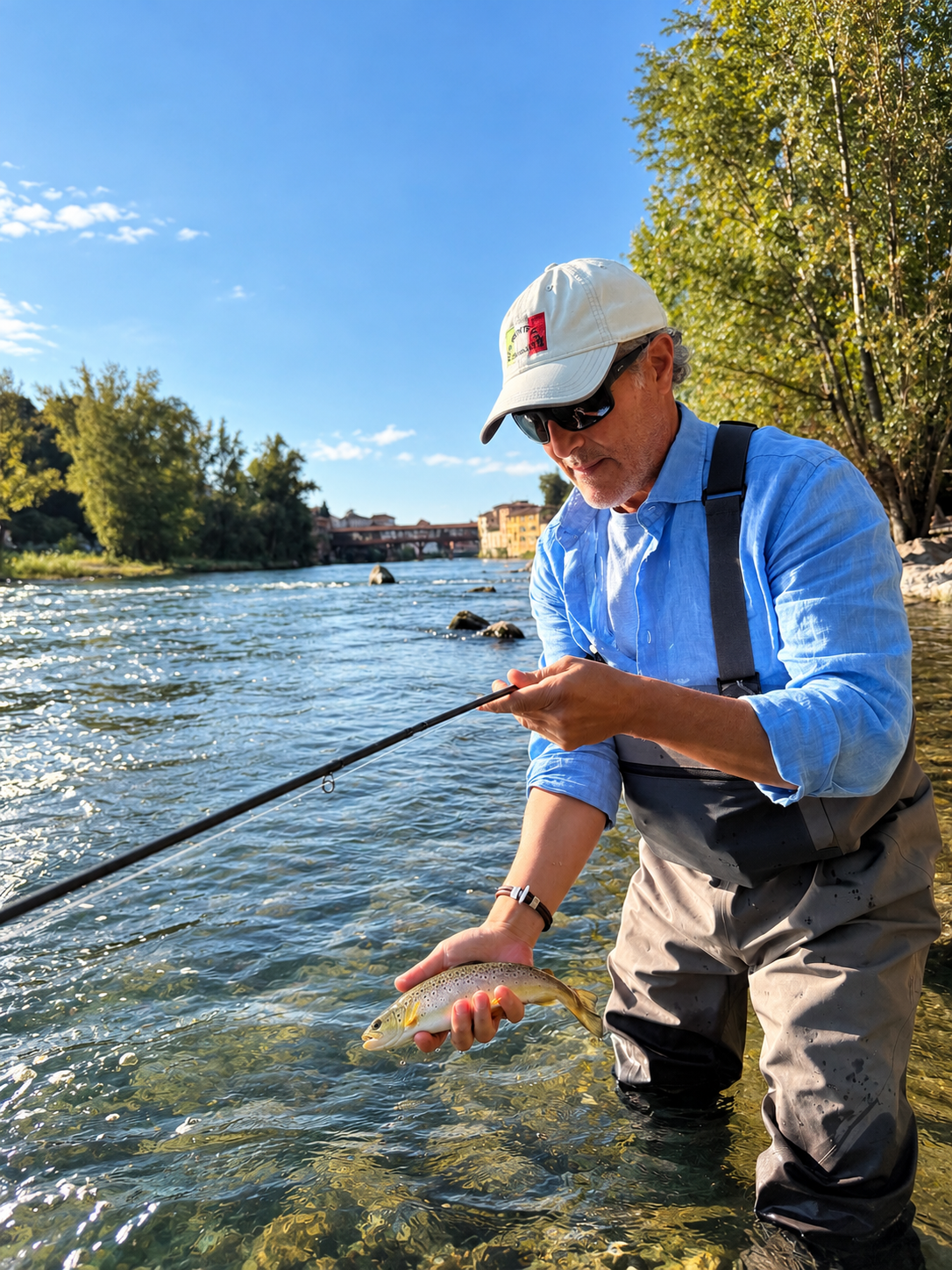
The Brenta holds many of the trout species you would hope to encounter in Northern Italy. There are brown trout, rainbow trout, marble trout and hybrids between brown and marble trout.
One of the things I love about the Brenta is the quality of its fish. Trout over 20 inches are not unusual, and in the right water there is always the possibility of meeting something really special.
Brown trout and rainbow trout make up most of the catches during a typical day. Marble trout are a rarer presence. They are there, and occasionally they appear when you least expect them, but specifically targeting a large marble trout is a different game and deserves a fishing strategy of its own.
The First Thing I Look At Is the Angler
Before deciding where to fish, I want to understand the angler who will be with me that day.
The best stretch of the Brenta for an experienced streamer fisherman may be completely wrong for someone who is relatively new to fly fishing. If I am guiding a less experienced angler, my first objective is to put that person in a situation where he or she can fish comfortably, have fun and have realistic chances of catching fish.
With an experienced or very experienced angler, I can make different choices. We may fish technically demanding water if that gives us a better chance of encountering an exceptional trout.
Personal preferences matter just as much. Someone curious about Euro nymphing should fish water where that technique can really show what it can do. A streamer fisherman needs different water. Someone who loves dry-fly fishing needs another kind of situation again.
There is no single best stretch of the Brenta. There is the best stretch for that angler, on that particular day.
Don’t Try to Bend the River to Your Wishes
For me, one of the most important principles in fly fishing is not trying to bend the river to your wishes.
I always want to know how an angler loves to fish. But when someone is also open to adapting during the day, the Brenta really shows what it can offer.
We might begin with Euro nymphing, move to streamer fishing, switch to a dry-dropper and later find an opportunity to fish a classic dry fly. Without forcing anything, it is perfectly realistic to use three or four different fly-fishing approaches during the same day on the Brenta.
That does not mean changing technique every twenty minutes just for the sake of it. It means being ready to change when the conditions give us a reason to do so.
A typical guided day starts around 8:30 AM and finishes around 5:00 PM. We can meet at an agreed location, or I can pick you up directly from your hotel so you do not have to worry about logistics.
Where we fish is deliberately not decided according to a fixed itinerary. River levels, weather, current conditions, your technical level and your preferred style of fishing all influence the decision. Knowing the Brenta means knowing where to go when the river shows a particular face.
During the day we may stay in one area or move between different stretches. We may also change technique if the river gives us a reason to do so. The objective is not to follow a schedule. It is to make the best possible use of the conditions we have that day.
Lunch Can Be Part of the Experience
Lunch follows the same philosophy as the fishing: it depends on you.
If you do not want to lose fishing time, we can grab a quick sandwich and eat beside the river. We can organize a more complete riverside picnic with local products, or we can stop for an hour at one of the traditional restaurants along the Brenta and enjoy a proper Italian lunch.
Personally, I think stopping for something genuinely good and genuinely Italian is never a bad idea — but it is your fishing day.
How Much Walking Is Involved?
The physical intensity of the day can also be adapted to the angler.
If you prefer an easy day, we can choose accessible water and sometimes walk no more than a third of a mile during the entire day. If you enjoy covering water and want a physically active fishing day, we can walk several miles — even close to nine miles in a full day.
That is another advantage of having almost 20 miles of fishable river available: we can adapt not only the technique and the water, but also the physical intensity of the day.
Do You Need to Be an Expert?
No. The Brenta is not a difficult river in absolute terms.
Knowing the river makes an enormous difference. You do not need to cast across it to catch a big trout. In the right place, a 30-foot cast can put your fly in front of a very serious fish.
At the same time, the Brenta can be extremely technical if that is what an experienced angler is looking for. There are situations where presentation, positioning, line control and reading the current require a high level of skill.
My job as a guide is not to demonstrate how difficult the river can be. It is to put each angler in the best possible situation for his or her technical level.
Teaching — When You Want It
How much I teach depends entirely on the angler. Some people come to the Brenta specifically because they want to improve a technique, and in that case we can spend real time working on it. Others are already very experienced and simply want local knowledge: the right stretch, the right position and sometimes just the right fly.
Normally, I take care of the leaders, the flies and the setup. I explain where and how I would make the cast, and when I see something that could make the fishing more effective, I suggest it.
I do not want a guided day to feel like a lesson unless you want a lesson. Sometimes the best guidance is teaching. Sometimes it is simply knowing when to say something — and when to let someone fish.
Numbers or the Fish of a Lifetime?
Of course, there are no guarantees in fly fishing. But on many normal fishing days, when the objective is simply to enjoy the river and adapt to the conditions, catching around ten trout — perhaps with a couple of particularly good fish among them — is entirely possible.
The equation changes completely if you decide to hunt for something exceptional.
If an experienced angler tells me, “Matteo, I don’t care about numbers. I want to look for the fish of a lifetime,” we may spend the day fishing streamers in water where a big marble trout could be holding. At that point, one or two fish can make a very successful day. There is also the possibility that the fish we are looking for simply is not active.
That is a conscious choice. You are trading numbers for the possibility of something extraordinary.
The Brenta often gives you fish. But it also gives you the choice of what kind of fish you want to look for.
There Is Always a Plan B
River conditions can change, and part of my job is knowing how to react. There is always a Plan B — and usually a Plan C.
Sometimes that means changing the stretch we had originally considered. Sometimes it means changing the technique. And when necessary, it can mean changing the plan completely.
The one thing nobody can control is the weather. There are conditions in which it simply is not sensible to fish, just as anywhere else in the world. But before reaching that point, there are normally several alternatives available.
When you book a guide, you are not booking a spot. You are booking someone who knows what to do when the original plan stops making sense.
A River That Changes With the Season
There is not one perfect month for the Brenta. There are different Brentas throughout the season.
The season normally begins in March, and the early weeks can be surprisingly exciting. Large mayflies can hatch at this time, and some of the bigger trout may become active on the surface. A large fish rising to a dry fly at the beginning of the season is one of the great surprises the Brenta can offer.
As the season progresses, the character of the fishing changes. June, July and August can still provide extremely entertaining fishing despite the heat. One of my favorite summer approaches is fishing very large dry flies such as Chernobyl Ants and Fat Alberts, sometimes tied on hooks as large as #2 or #4.
Watching a 20- to 24-inch trout come up through powerful, turbulent water to eat a huge dry fly is difficult to forget.
September and October are two of my favorite months. Temperatures begin to fall, fish can remain active for longer periods during the day, and once again we can successfully use a wide range of techniques. In recent years, October has often provided particularly interesting fishing conditions.
One Fishing Day Inside Your Italian Vacation
You do not need to plan a fishing vacation to fish the Brenta. You can simply add one great fishing day to your Italian vacation.
Bassano del Grappa is roughly an hour to an hour and ten minutes from Venice by car, which makes a day trip completely realistic. You can leave Venice in the morning, spend a full day fly fishing on the Brenta and be back in Venice in time for dinner with your wife, partner or family.
And if your partner wants to come along, even better. Bassano del Grappa is a destination in its own right, with history, architecture, food and plenty to discover while you are fishing. It can become a beautiful day trip for both of you — even if only one of you carries a fly rod.
What Should You Bring?
Potentially, you do not need to travel with any fishing equipment at all.
If you are travelling through Italy and do not want to bring rods, reels, waders and boots across the Atlantic, you do not have to. We can organize the equipment you need, as well as the flies and setups appropriate for the period and the fishing we decide to do.
If you prefer to fish with your own equipment, a 9-foot #5 is probably the most versatile rod for the Brenta. It can cover dry-fly fishing, sight nymphing, dry-dropper fishing and a large part of the general fishing we may encounter.
For dedicated Euro nymphing, a rod of 10 feet or longer is useful. If streamer fishing is part of the plan, a 9-foot #8 is a very good choice.
Bring your own rods if you enjoy fishing with familiar equipment. Otherwise, just come fishing.
A Guided Day Should Give You Something to Take Home
For me, a successful guided day is not measured only by the number of trout caught. First of all, it should be fun. But I also want an angler to leave the river having learned something.
Every river is different, and some of the approaches that work on the Brenta may be useful when that angler returns to his or her home water. Euro nymphing is a good example. Many visiting anglers are particularly curious about it and may already have some experience, but fishing it on the Brenta can reveal a different level of positioning, line control and presentation.
One of the comments I enjoy hearing most at the end of a day is: “I can’t wait to try this setup on my home river. I’m going to catch three times as many fish as my friends.”
That means the experience continues after the day on the Brenta is over.
For me, guiding is not about waiting for 5 PM. Of course I want you to catch fish, and I will work hard to make that happen. But fishing has always meant more to me than the number of trout in the net.
It is about enjoying the river, learning something, laughing, discovering a new place and going back to your hotel thinking: that was a really good day.
At the end of the day, I do not need someone to tell me they caught the biggest trout of their life. If they tell me they had fun, that they saw a river unlike anything they had fished before, that they experienced something new and learned something they can take home with them, then for me it was a successful day.
Why Spend One of Your Days in Italy Fly Fishing the Brenta?
Because I believe it will be one of those experiences you will never forget.
Not only because of the trout. You may catch a beautiful brown, a big rainbow or perhaps even encounter a marble trout. But years later, you may remember something completely different.
Fishing through the streets of Bassano. An old bridge behind you. Moving upstream until the buildings slowly disappear. The forest. The sound of the river. A good Italian lunch. Something new you learned. A fish rising where you did not expect it.
That is the Brenta.
And if you are visiting Venice, it is only about an hour away.
Come Fish the Brenta
You do not need to know which stretch to fish, which technique will work or which flies to bring. That is my job.
Your job is much simpler: come to the Brenta and see what kind of river it decides to be that day.
If you are coming to Venice or travelling through Northern Italy and want to spend a day on the Brenta, tell me how you like to fish. I’ll take care of the rest.
Check availability for a private guided day on the Brenta